
The Server Is in Jakarta. Where Does the Model Run? Five Layers of AI Sovereignty
A Jakarta data center is only one of five layers. Check data, compute, model, operations, and contracts before an AI project goes to production.
An AI project is sovereign only when its data, compute, model, operations, and contracts all sit under Indonesian jurisdiction. A server in Jakarta answers just one of those five. On bank, state-owned enterprise, or government projects, the layer that gets missed usually surfaces during the client's security review.
Why doesn't "the servers are in Indonesia" settle the question?
Personal data can leave through routes other than storage. Prompts sent to a model API abroad, application logs forwarded to a global monitoring service, and admin access from another country can each count as a transfer. Security teams at regulated clients now trace all of these paths, not just the data center address.
Government is starting to use the same framing. In August 2026, Said Mirza Pahlevi, Director of AI Ecosystem and New Technology at Komdigi (Indonesia's Ministry of Communication and Digital Affairs), said AI sovereignty is "not only about models". In his description, the infrastructure covers data, GPUs, cloud, data centers, platforms, and security. The draft Presidential Regulation on the 2026-2029 National AI Roadmap, which includes this infrastructure pillar, was still awaiting the President's approval as of August 2026 reports.
On the data protection side, Government Regulation (PP) 33/2026 was promulgated on 16 July 2026 and takes full effect on 16 January 2027. Several law firms advise organizations to map where personal data is stored, accessed, and transferred outside Indonesia. Those are three separate questions, and a project can be clean on storage while still failing on access.
What are the five layers of AI sovereignty?
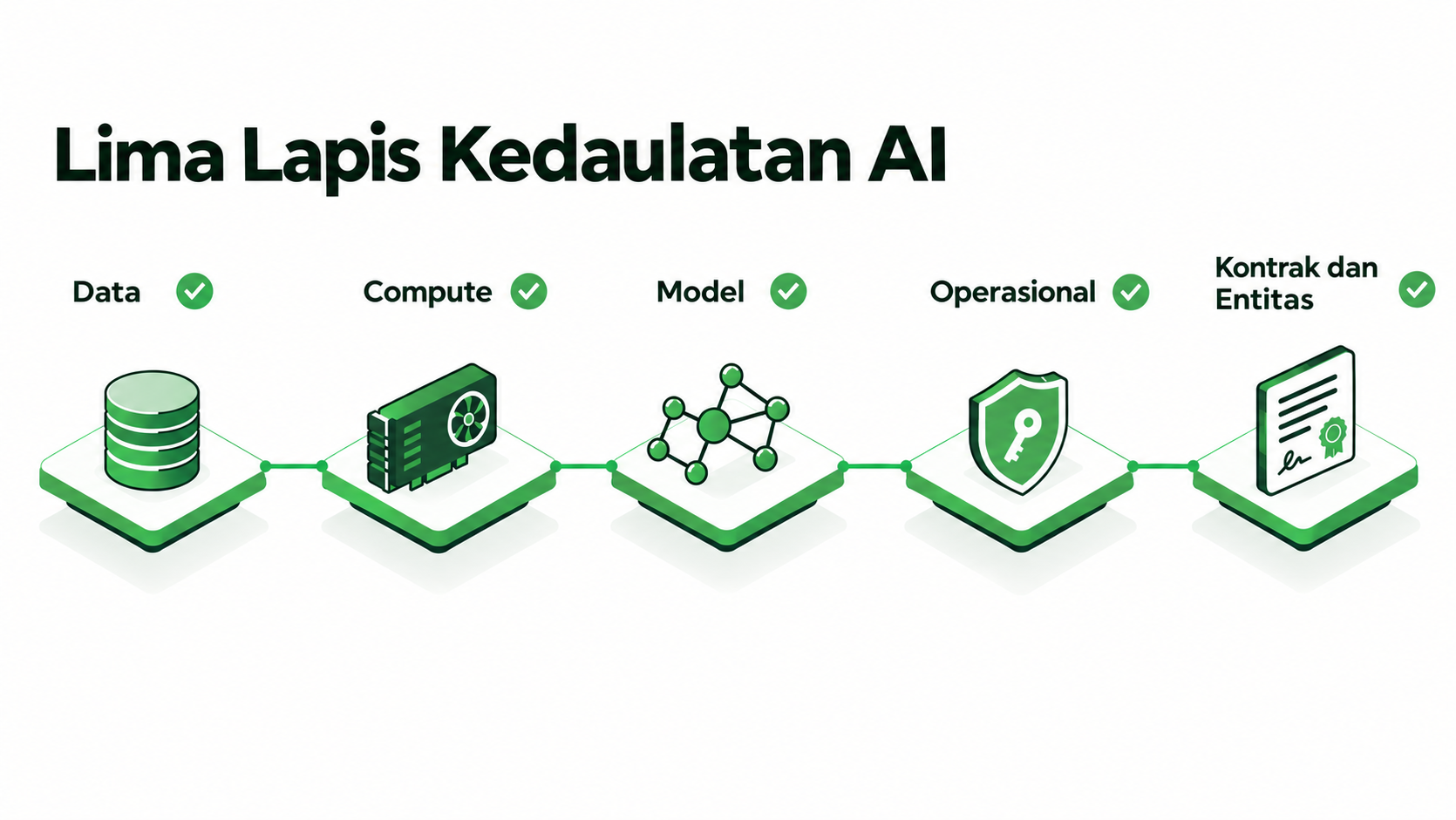
The five layers are data, compute, model, operations, and contracts and legal entity. Each one asks the same thing: where does this happen, and who controls it? To an auditor, one leaking layer is as serious as four tidy ones.
| Layer | Question to answer | Common gap |
|---|---|---|
| 1. Data | Where are data, embeddings, logs, snapshots, and backups stored? | Backups or application logs forwarded to a global service |
| 2. Compute | Where do inference and fine-tuning actually run? | Application in Jakarta, inference calls routed to a region abroad |
| 3. Model | Who controls the model and its version? | Reliance on a closed model API that can change or be discontinued unilaterally |
| 4. Operations | Who has admin, support, and monitoring access? | Sub-processors or support staff abroad can open the data |
| 5. Contract and entity | Which law governs, which entity signs, and in what currency is the invoice? | Contract under foreign law, invoices in USD |
Why is the model layer missed most often?
Teams tend to treat the model as an application feature rather than infrastructure. But when an application calls a closed model API from a foreign provider, every prompt and every piece of RAG context goes with it. Model versions can also change without the client's control, so output that passed UAT may drift after go-live.
Open-weight models offer another route. The weights can be deployed on GPUs inside Indonesia, the version is pinned, and prompts never leave an environment the team controls. Open-weight is not automatically safe, though. Teams still need to check the license for commercial use, test quality in Bahasa Indonesia, and record the exact version in the project documentation. For help choosing a model for Indonesian-language documents, see open-weight models for document extraction.
What about operations and sub-processors?
The operations layer answers who can see the data once the system is live. PP 33/2026 requires a written agreement with the processor and written approval from the controller before a sub-processor is involved. That means any monitoring, ticketing, or support service that can open logs containing personal data belongs on the project's sub-processor list.
Five questions an SI can put to its own team:
- Which services receive application logs or traces, and where do they run?
- Who has admin access to the cluster and storage, and where do they log in from?
- Are backups and snapshots stored in the same region as the primary data?
- Does any third party handle incident response or first-line support?
- Is the sub-processor list written into the contract and approved by the client?
Why do the contract and the billing currency count?
Sovereignty also covers which law applies when there is a dispute or a request for data. A provider with an Indonesian legal entity, a contract under Indonesian law, and invoices in rupiah is easier for a client's legal and procurement teams to approve. Rupiah billing also removes exchange-rate risk from a project budget that has already been locked.
When should the five layers be checked?
Before the proposal goes out, not after the pilot ends. Many AI projects stall at the pilot stage because compliance questions only appear when the client starts preparing for production. If all five layers are answered in the proposal, the client's security review becomes verification rather than discovery. For how to write this into tender documents, see answering data residency questions in an RFP.
A short checklist before sending a proposal:
- A data flow diagram showing where storage, inference, logs, and backups sit.
- The model name and version, and where it is deployed.
- A list of sub-processors and the location of each.
- An admin and support access matrix.
- The infrastructure provider's legal entity, the law governing the contract, and the invoice currency.
- Evidence of the provider's information security certification, including the certificate number.
Where does IONext fit?
IONext covers the infrastructure side of the data, compute, model, and contract and entity layers. NVIDIA RTX PRO 6000 Blackwell Server Edition 96GB and NVIDIA L40S 48GB GPUs are in Jakarta, and so is the storage. Managed inference through an OpenAI-compatible API is processed in Jakarta. IONext is operated by PT Data Awan Nusantara, an Indonesian legal entity, with billing in rupiah and ISO/IEC 27001:2022 certification from TÜV NORD (certificate no. 01 07 E 26000410). Details are on the IONext Trust page and the GPU cloud in Jakarta page.
The boundaries matter too. As of October 2026, IONext's managed model catalog is still limited, and some open-weight models are available for self-deployment on IONext GPUs. The operations layer at the application level, such as who on the SI or client team has access and which monitoring services the application uses, remains the responsibility of the SI and the client. IONext also does not make a client project automatically compliant with the PDP Law: compliance depends on how the data controller processes data. ORBIT helps teams see the workloads they are running, and IONA reads production signals so problems surface sooner.
For SIs preparing AI projects in regulated sectors, the IONext Partner Program helps build the data sovereignty answers together with the IONext team. To try ORBIT and IONA first, sign up at the IONext console.
Frequently asked questions
Is data residency the same as AI sovereignty? No. Data residency only answers where data is stored. AI sovereignty also covers where inference runs, who controls the model, who holds operational access, and which law governs the contract.
If the application is in Jakarta but calls a model API from abroad, does data leave Indonesia? Yes. The prompts and context sent to that API are processed outside Indonesia. If they contain personal data, the route needs to be assessed under the cross-border transfer rules in the PDP Law and PP 33/2026.
Has the PDP supervisory agency been established yet? As of September 2026, the PDP supervisory agency was not yet fully established, according to law firm summaries. Some transfer mechanisms, such as the list of countries with equivalent protection and standard contractual clauses, are still waiting for rules from that agency. The situation is worth tracking before 16 January 2027.
Sources
- Law No. 27 of 2022 on Personal Data Protection, JDIH BPK (in Indonesian)
- RSM Indonesia, PP 33/2026: Six Implementation Priorities before 16 January 2027 (18 September 2026)
- SIP Law Firm, PP 33/2026 on Personal Data Protection (23 October 2026) (in Indonesian)
- Infobanknews, Komdigi Prepares the 2026-2029 AI Roadmap (27 August 2026) (in Indonesian)
- JDIH Komdigi, Working Committee Meeting on the Draft Presidential Regulation for the National AI Roadmap (12 February 2026) (in Indonesian)
This article is general information, not legal advice. For compliance decisions on a specific project, consult legal counsel.
IONext is sovereign AI infrastructure hosted in Indonesia, operated by PT Data Awan Nusantara in Jakarta. IONext provides GPU as a Service, managed inference through an OpenAI-compatible API, and open-weight model hosting, certified to ISO/IEC 27001:2022 by TÜV NORD.