
Choosing Open-Weight Models for Indonesian Document Extraction
How to pick an open-weight model for extracting Indonesian KTPs, payslips and bank statements, five checks to run before accuracy testing, and why the evaluation stays onshore.
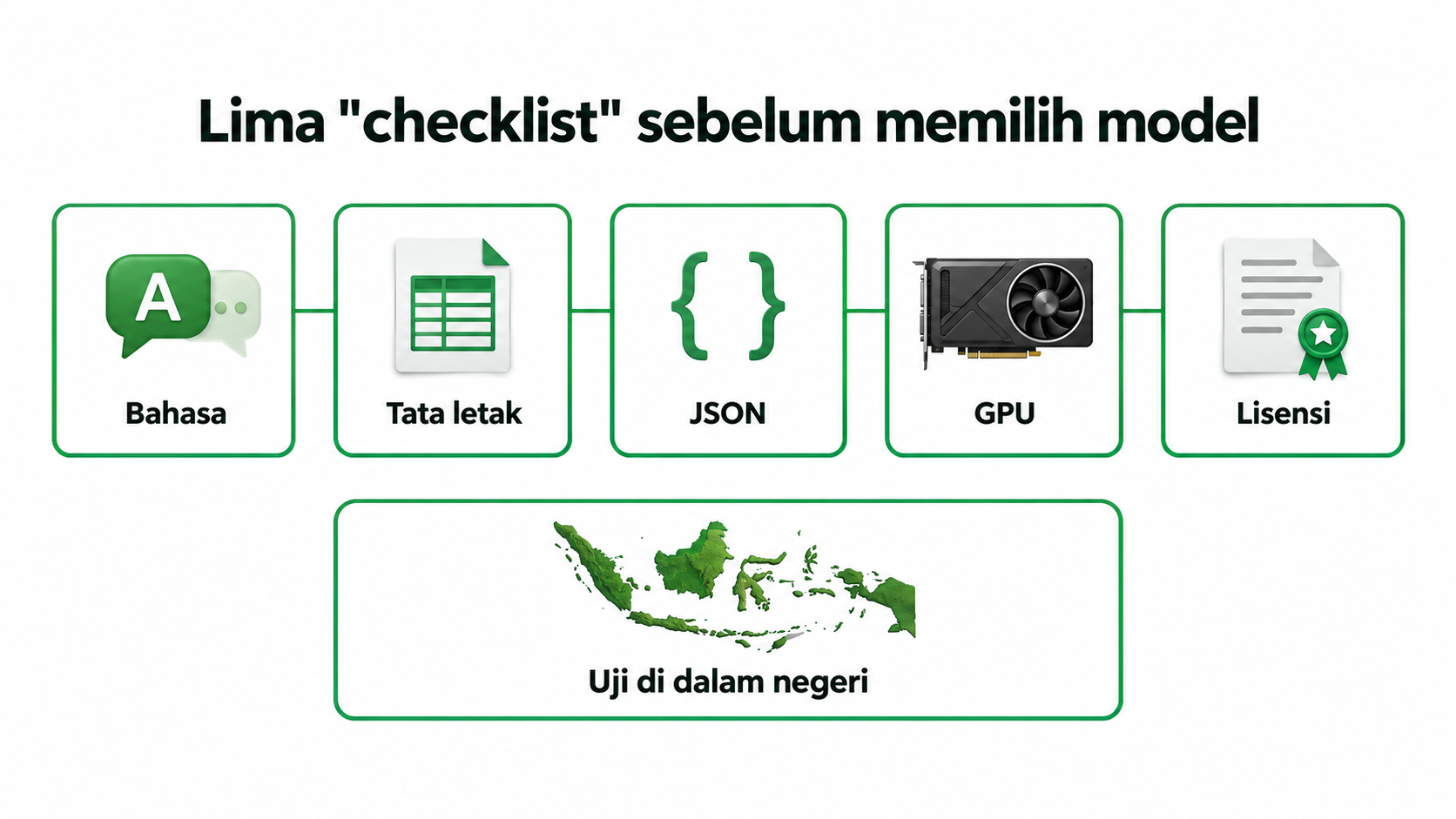
The right open-weight model for extracting Indonesian-language documents comes from testing on the client's own document samples, not from a general benchmark leaderboard. Before running that test, check five things: language coverage, document type, structured output, GPU requirements, and license.
This is a design pattern that can be built on IONext, not a report on a specific project. For the full architecture, from storage through to observability, see Document AI and OCR for customer documents without data leaving Indonesia.
What to check before choosing a model
Run these five checks before any accuracy test: does the model handle Indonesian, does it match the document's layout, can it follow a JSON schema, what GPU does it need, and is the license cleared for commercial use. If a model fails any one of these, there's no need to test it further.
| Question | Why it matters | How to check (as of October 2026) |
|---|---|---|
| Does it support Indonesian and the Latin script? | Models trained mostly on English often misread local abbreviations, names and address formats | Check the model card: Granite-Docling lists English as its primary focus, while PaddleOCR-VL claims support for 109 languages |
| Is the document fixed-layout or table-heavy? | KTPs and NPWPs work well with OCR plus a text LLM; bank statements need table analysis or a vision-language model | Test each document type on its own, don't mix them |
| Can the model follow a JSON schema? | An unreadable field should return null, not a guess |
Confirm the inference server supports structured output or JSON schema enforcement |
| What GPU does it fit on? | Small OCR models can share a GPU with other components; a 27B-class model needs considerably more VRAM | Measure memory use with realistic document lengths and batch sizes |
| Is commercial use allowed? | An SI's client project counts as commercial use | Check each model's license file: PaddleOCR-VL and Granite-Docling both ship under Apache-2.0 |
How to test it without turning a small project into a long research effort
Put together a few dozen documents per type, label the ground truth by hand, and compare two or three candidate models against the same metrics. Beyond per-field accuracy, track how often a model fills in a field that's actually illegible. For customer documents, that number matters more than average accuracy.
Run the evaluation on domestic infrastructure. Test samples that haven't been fully anonymized are still personal data, and under the PDP Law, bank statements and payslips count as personal financial data.
Where IONext fits
IONext supports this pattern two ways, both hosted in Jakarta. The first is managed inference through the OpenAI-compatible API: as of 12 October 2026 the catalog includes Qwen3.8-27B, which accepts image input and supports structured output. The second is GPU VMs on the NVIDIA L40S 48GB or NVIDIA RTX PRO 6000 Blackwell Server Edition 96GB, for teams that want to self-host an OCR model such as PaddleOCR-VL, managed through ORBIT and monitored with IONA.
IONext doesn't choose the model for a client project and doesn't publish accuracy figures. Evaluation results stay with the SI team and the client.
To try ORBIT and IONA, create an account on the IONext console. For SIs preparing a Document AI proposal for a client, talk to us through the IONext Partner Program.
Sources
- PaddleOCR-VL, model card on Hugging Face
- Granite-Docling-258M, model card on Hugging Face
- IONext llms.txt, managed inference model catalog
- Law No. 27 of 2022, article text on Pasal.id
- IONext Signals: Document AI and OCR for customer documents
This article is a general explanation and not legal advice. Consult your legal advisor on the application of the PDP Law, PP 33/2026 and POJK.
IONext is sovereign AI infrastructure hosted in Indonesia, operated by PT Data Awan Nusantara in Jakarta. IONext provides GPU as a Service, managed inference through an OpenAI-compatible API, and open-weight model hosting, certified to ISO/IEC 27001:2022 by TÜV NORD.