
After Go-Live: The Signals IONA Reads in Production, and Who Acts on Them
When a client's AI workload goes live, what do you monitor? The production signals IONA reads in ORBIT, who acts on them, and the link to Indonesia's PDP Law.
AI workloads rarely break on launch day. The problems creep in after go-live: memory usage climbing steadily, one pipeline step stalling, model output drifting, or a database that turns out to be exposed to the internet. IONA, the operational intelligence layer inside ORBIT, reads those signals, explains what they mean in plain language, and shows what to check first. The decision stays with your team.
What changes once a client workload is in production?
After go-live, the question stops being "does it work" and becomes "is it still healthy today". Real data starts flowing in, load fluctuates, and the model meets inputs that never appeared in test data. For a systems integrator, this phase decides whether the project earns the next contract or dies at the pilot.
Three things usually overwhelm an SI team here:
- Signals live everywhere. VM metrics, pipeline logs, and model behavior sit in different dashboards. Connecting a symptom to its root cause takes time.
- Different expertise focus. SI teams are strong on the use case, computer vision or document processing for instance, not on infrastructure sizing and day-to-day operations.
- Unwritten ownership. When the alert fires at 2 a.m., nobody is sure who has to make the call.
As of October 2026, NIST is also pushing AI systems away from "deploy and forget" toward continuous monitoring and regular updates. Post-go-live monitoring is not an add-on; it is part of the design from day one.
What signals does IONA read?
IONA reads signals from the infrastructure, models, and pipelines running in ORBIT, explains what they mean, and recommends the next step. As of October 2026, they fall into five groups: production health, model drift, pipeline failure, exposed resources, and recovery during an incident.
The detail, based on the IONA and ORBIT product pages:
- Production health. ORBIT watches memory, storage, and health checks on every resource continuously. IONA explains what a change means, for example a GPU VM's memory climbing and needing a team decision.
- Model drift.* IONA flags it when a running model's behavior starts to shift from its previous pattern.
- Pipeline failure. Pipeline execution traces step by step on the same canvas, so the team does not tear apart the whole process to find one broken step.
- Exposed resources.* IONA flags resources open to the public, such as a database with a public IP, before they become a data leak. ORBIT shows every resource's public or private status.
- Recovery. During an incident, IONA explains what is still recoverable. ORBIT provides snapshots and restores without breaking connections between resources.
* This feature is still in development.
Who acts when a signal appears?
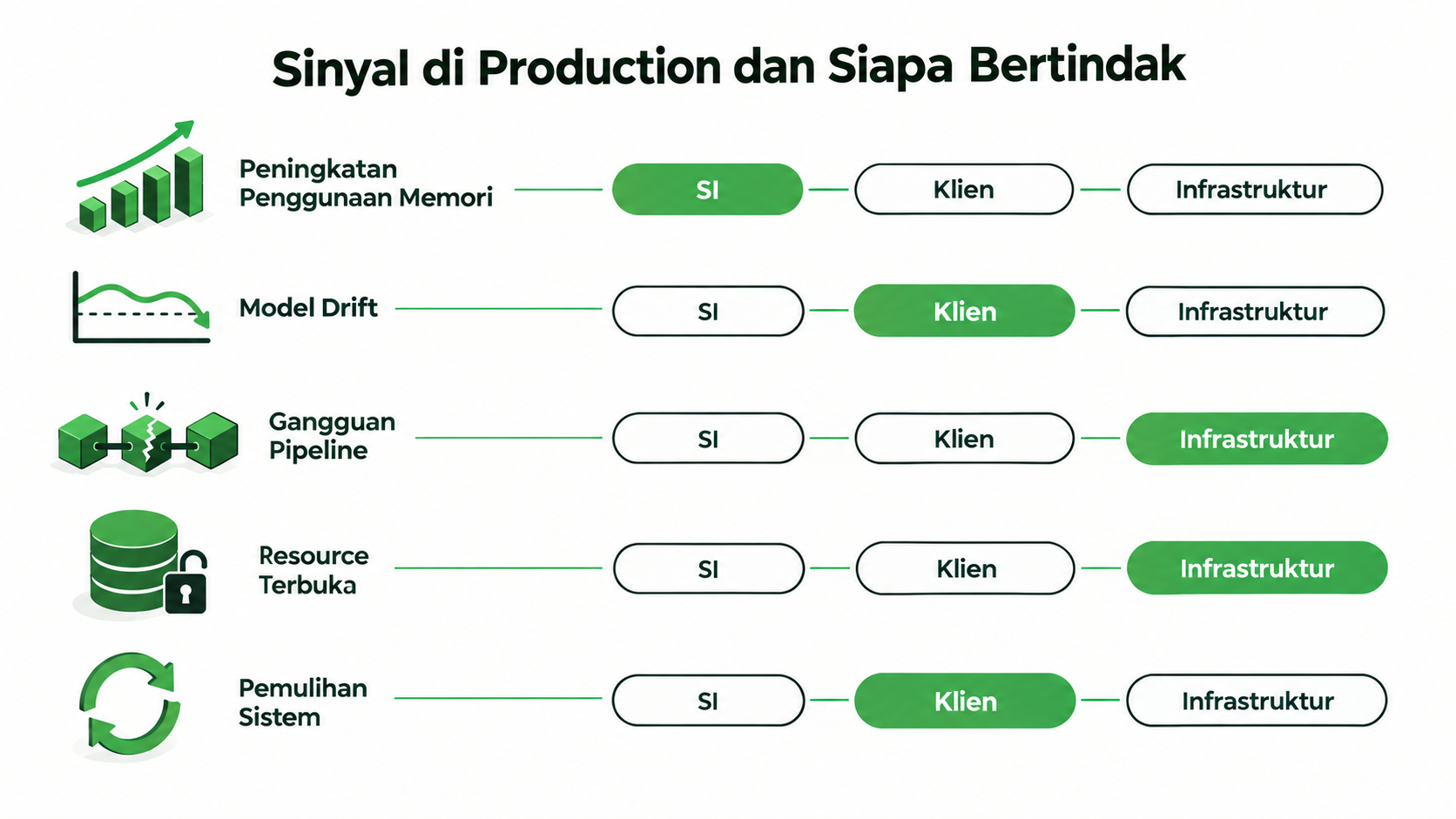
IONA explains and recommends; it does not take over the decision. On a client project, the systems integrator keeps the client relationship and first-line support, the client owns decisions about their data, and IONext owns the infrastructure layer. The table below is ready to drop into a project operations document.
| Signal | What it means | What you see in ORBIT and IONA | Who decides | Compliance note |
|---|---|---|---|---|
| Memory or storage keeps rising | Capacity can run out if the trend continues | Per-resource metrics, trend explanation, scale-up options | SI, with client approval if costs change | Not immediate, unless it takes the service down |
| Model drift | Inputs or model behavior shift from baseline | Drift flag from IONA | SI (re-evaluate the model), client (is the output still acceptable) | Must be documented if the model processes personal data |
| Pipeline stalls | One step fails, data sits waiting | The failed step on the canvas, with its logs | SI | Make sure stranded data is not copied elsewhere |
| Exposed resource | Data is reachable from the internet | Public or private status, flag from IONA | SI closes access, client notified immediately | Can constitute a failure to protect personal data |
| Incident and recovery | Service or data is affected | Snapshots, restore, what is still recoverable | SI leads incident response, client decides on notification | As controller, the client owns the notification duty |
Why an exposed resource is a PDP Law issue, not just an IT issue
Indonesia's Personal Data Protection Law (Law No. 27/2022) requires the personal data controller to protect the data it processes and ensure its security (Article 35), and to notify data subjects and the authority in writing within 3 x 24 hours of a failure to protect personal data, a data breach (Article 46). An AI database open to the public can trigger that duty.
The Article 46 notification must state which personal data was exposed, when and how it was exposed, and what remediation and recovery efforts are underway. All three are hard to answer quickly if the team does not know how long a resource has been exposed or what is still recoverable. This is where operational signals become compliance evidence.
Government Regulation No. 33/2026, the implementing regulation for the PDP Law effective 16 January 2027, clarifies the roles of controller, processor, and sub-processor. For an SI, that means the escalation path from technical alert to client notification decision must be written down before go-live, not assembled during the incident. The full discussion is in PP 33/2026 and what it means for AI projects.
Getting IONA into your project runbook
Start at the sizing stage, not when something breaks. IONA can recommend the VM and model configuration for a use case before the build, then monitor the same workload once it is live. The checklist below helps an SI team set up daily operations from kickoff.
- Describe the use case to IONA before the build. Name the load pattern, peak hours for example, so sizing recommendations follow peak load, not the average.
- Separate environments. Create separate projects and environments in ORBIT for staging and production, one set per client.
- Check exposure before go-live. Only the gateway that must be public stays public. Databases and storage stay private.
- Take a baseline snapshot. Save a snapshot after the production configuration is approved by the client.
- Map each signal group to a named owner. Use the table above. Write down a person's name, not a job title.
- Write the client escalation path. Decide which signals must be reported to the client and within what time frame, referencing Article 46.
- Schedule drift reviews. Agree with the client when model output gets reviewed again and who approves a model swap.
- Test restore at least once before handover. Restore from a snapshot in staging, and document the result as evidence.
Where IONext fits
IONext provides AI infrastructure in Jakarta: NVIDIA RTX PRO 6000 Blackwell and L40S GPUs, managed inference through an OpenAI-compatible API, ORBIT as the workspace, and IONA as its operational intelligence layer. Data is processed and stored in Indonesia, with ISO/IEC 27001:2022 certification from TÜV NORD and billing in Indonesian Rupiah through an Indonesian legal entity, PT Data Awan Nusantara.
The limits are worth stating clearly:
- IONA is not a standalone product and it does not replace a DevOps engineer or an ML engineer. It helps a lean team read signals faster.
- IONA recommends; the team decides. Actions such as scale-up, remediation, or recovery still need team approval.
- Recovery is not always complete. IONA explains what is still recoverable. Backup policy still has to be designed up front.
- Domestic infrastructure does not make a project automatically PDP-compliant. Lawful basis, processing agreements, and notifications remain the controller's and processor's responsibility.
- The SI stays in front of the client. IONext works under the systems integrator, not beside it. The role split is covered in Who Holds What.
Certification and data residency detail is on the IONext Security and Compliance page. GPU specifications are on the GPU cloud in Jakarta page. How both products work is on the ORBIT and IONA pages.
Try it yourself: create an account on the IONext console to explore ORBIT and IONA. For systems integrators bringing IONext into client projects, see the IONext Partner Program.
Frequently asked questions
Does IONA take automatic action without approval? As of October 2026, IONA explains the signal and recommends the next step; the team decides. For example, when a VM's memory keeps rising, IONA marks the condition as one that needs a team decision. Provisioning from a recommendation also only runs after approval.
What is the difference between infrastructure monitoring and model monitoring? Infrastructure monitoring looks at VMs, storage, and network: are the resources healthy and is capacity sufficient. Model monitoring checks whether the model's behavior still matches expectations. A workload can be healthy on the infrastructure side while its output drifts. IONA reads both from one place.
If a client project has an exposed database, who must report it? Under Article 46 of Law No. 27/2022, the notification duty sits with the personal data controller, which is usually the client. The SI, as processor, has to relay the information as fast as possible so the client can meet the 3 x 24 hour limit. This path should be written into the processing agreement.
Sources
- Law No. 27 of 2022 on Personal Data Protection, Articles 35 and 46
- Article 46 of Law No. 27/2022: notification of a failure to protect personal data
- Government Regulation No. 33 of 2026 on the implementation of the PDP Law (effective 16 January 2027)
- Cloud Security Alliance, summary of NIST research on the continuous-monitor-and-update model for AI systems (June 2026)
- IONA and ORBIT product pages, accessed 16 October 2026
- ORBIT and IONA, how they work together
This article is a general explanation, not legal advice.